
Portugal has been undergoing one of the most significant workforce transformations in Europe, and employers should be paying attention, as what’s happening there could offer a preview of what comes next for the wider European workforce.
Over the past decade, the country’s foreign-born population has doubled. Today, around one in seven people living in Portugal was born overseas, making immigration an increasingly important part of the country’s labor market and economic stability.
At first glance, Portugal may not seem like the obvious place to look for insight into the future of work. But many of the pressures it’s experiencing, such as an aging population, skills shortages, housing challenges, and growing reliance on international talent, are the same issues shaping hiring strategies across Europe.
International talent is becoming essential to economic growth
According to recent data, more than 1.1 million foreign workers now contribute to Portugal’s social security system, accounting for roughly one in five taxpayers and contributing an estimated €4.1 billion annually.
That level of contribution highlights how critical international hiring has become, particularly in industries where labor shortages are already being felt. Sectors such as construction, healthcare, hospitality, and technology increasingly rely on overseas talent to fill gaps that domestic labor markets alone cannot meet.
This isn’t unique to Portugal. Across Europe, businesses face growing competition for skilled workers while local populations continue to age. The Organization for Economic Co-operation and Development (OECD) has repeatedly warned that labor shortages and demographic decline pose long-term risks to economic growth if countries fail to adapt.
Portugal simply happens to be further along in that transition than many others.
Hiring globally is not a future trend
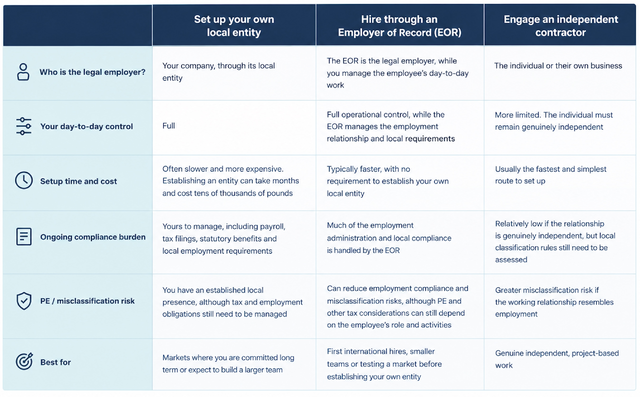
We’ve seen a noticeable increase in inquiries related to hiring in Portugal over the past 12 months. Businesses are becoming more open to cross-border hiring models, not just to solve immediate recruitment challenges but to build more resilient and scalable teams.
What’s particularly interesting is that Portugal is attracting highly skilled international professionals, yet OECD findings suggest many foreign workers remain overqualified for the roles they occupy.
That points to the next phase of workforce evolution. Attracting talent is only part of the equation. The bigger challenge is how countries and employers integrate, support, and fully utilize international talent once it arrives.
For businesses, that means thinking more strategically about global employment, remote hiring, workforce mobility, and long-term talent planning.
Europe’s workforce is becoming more interconnected
The idea of a purely local workforce is quickly disappearing. Companies are increasingly hiring across borders, employees are more mobile than ever, and talent shortages are forcing organizations to rethink where and how they recruit.
Portugal offers a useful example of what this transition looks like in practice.
For employers, the message is clear: workforce planning is no longer just a local issue. The organizations that adapt fastest to international hiring and evolving labor mobility will be in a much stronger position for the years ahead.
For more information, visit our Employer of Record Portugal page.