
Hiring internationally can open the door to a much wider talent pool but employing someone in another country involves far more than finding the right candidate and agreeing on a starting salary. Get the groundwork wrong, and you could face an unenforceable contract, an unexpected tax liability, or questions from local authorities about an employee your business has never formally registered.
Before making your first international hire, here are five key areas to consider.
1. Decide where you actually need to hire
The first question isn't necessarily "Which country do we want to hire in?" but "Where can we find the people we need?"
Think about the skills you're looking for, the available talent pool, time zones, proximity to customers or colleagues, and your wider expansion strategy. You also need to consider whether you're hiring one person to fill a specific skills gap or whether you're planning to build a team.
Ask:
· Where is the talent I actually need?
· Which time zones will work for my team?
· Is the role remote, hybrid, or office-based?
· Am I hiring one person or building a team?
2. Understand the local employment rules and the risks of getting them wrong
Employment law is local to each country, and rules you're familiar with at home don't necessarily translate elsewhere.
One common mistake is using a standard employment contract overseas without adapting it to local requirements. Notice periods, statutory benefits, working hours, leave and employer contributions can all vary significantly.
For example, notice periods in Germany can increase with length of service, while countries including Brazil, Mexico and the Philippines have statutory additional payments or benefits. In France, employer social security contributions can add significantly to the gross cost of employing someone.
None of this is necessarily intuitive if you have only ever hired in one country, so always assess the market you're hiring into.
There are also two wider risks to consider:
Permanent establishment risk
An employee working in another country can, depending on their role, activities and the jurisdiction involved, contribute to the creation of a permanent establishment and potentially local corporate tax obligations, even if your business has no office or legal entity there.
Misclassification risk
Engaging someone as a contractor to avoid employment obligations can be tempting, but many countries have strict tests around worker classification. If a relationship is found to be employment in practice, your business could face back taxes, penalties and claims relating to employment rights and benefits.
Before hiring, consider:
· Employment contracts
· Working hours and leave
· Employer taxes and social contributions
· Statutory benefits
· Notice and termination requirements
· Worker classification, including employee versuscontractor
3. Calculate the real cost, not just the salary
Salary is only one part of the cost of an international employee.
Employer taxes, social security contributions, statutory benefits, insurance, and payroll administration can all add to the total. These costs vary significantly between countries, which means comparing salaries alone can give you a misleading picture.
Establishing the total cost before making an offer lets you budget accurately and compare different markets on a genuinely like-for-like basis.
You should also consider the cost of establishing a local legal entity if that's the route you choose. Depending on the country and circumstances, this can run into tens of thousands of pounds and take months to set up, which may affect whether a particular market makes commercial sense.
4. Plan how you will manage the person day-to-day
Hiring someone overseas doesn't stop once the contract is signed. You also need to think about how that person will become part of the team and how the working relationship will operate day-to-day.
This includes time zones, communication, onboarding, equipment, IT access and performance management. If the employee is fully remote, they may never set foot in your physical office, so the processes around managing and supporting them need to work remotely too.
The difference between an international hire becoming a genuine part of the team and feeling like an outsourced afterthought often comes down to how deliberately the working relationship is planned.
Ask yourself:
· How will they be onboarded, and who isresponsible?
· Who will manage them day-to-day?
· How will the team communicate across differenttime zones?
· How will equipment and IT access be providedand supported remotely?
· How will performance be reviewed fairly,taking time zones and cultural differences into account?
5. Choose how you will legally employ them
Once you've decided where you need to hire, you need to establish how you will legally employ the person.
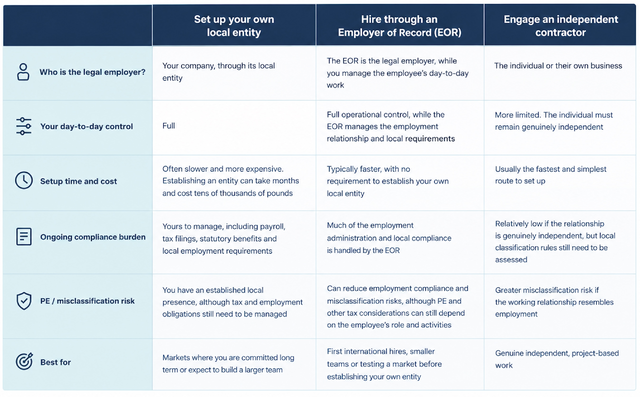
If your business doesn't have a legal presence in that country, simply putting an overseas employee on your existing payroll generally isn't an option. There are three broad routes available, each with different implications for control, cost, speed and compliance.
For a first international hire, or when testing a new market before committing to a permanent presence, an EOR can provide a straightforward way to employ someone compliantly without first establishing your own local entity. It can significantly reduce the administrative burden while giving businesses the flexibility to test a market before deciding whether a permanent local presence makes sense.
Getting ready for your first international hire
International hiring can give businesses access to skills and talent they may not be able to find in their home market, but it requires careful thought and preparation.
Before making an offer, make sure you understand the market you're hiring into, the local employment requirements, the full cost of employing someone, how they will fit into your existing team, and which employment model is right for your business.
Taking the time to get these areas right can help you avoid costly compliance problems and give your new employee a much better start.
And if you're still not sure, get in touch here https://agilityeor.com/contact, and we will guide you through your options.