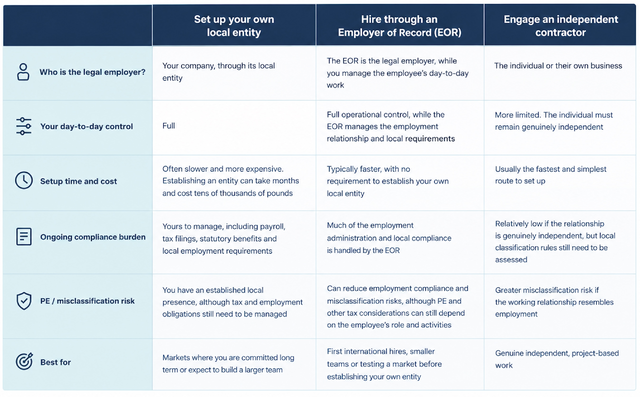

We often receive questions about the differences between an Employer of Record (EOR) and joint employment. While both typically involve multiple parties sharing employment-related responsibilities, they are not the same. Below is a snapshot of how they differ for UK businesses:
Employer of Record (EOR)
An Employer of Record is a third-party organization that serves as the official employer for tax and legal purposes. This arrangement is often chosen when a company wants to hire workers in a country where it doesn't have a legal entity. The EOR will handle administrative tasks like payroll, taxes, compliance, and benefits, while the client company continues to manage the day-to-day work of the employees.
- Key Features:
- The EOR is the legal employer.
- The client company directs the employees' work and projects.
- The EOR handles legal and regulatory obligations (e.g., tax withholding, employment contracts).
- Use When:
- Hiring international workers without having to set up a local entity.
- Outsourcing employment-related compliance.
Joint Employment
Joint employment occurs when two or more entities share control over an employee's working conditions and employment relationship. In this case, both entities may have legal responsibilities under employment laws. This arrangement often arises in situations like staffing agencies, franchises, or subcontracting relationships.
- Key Features:
- Both employers may be jointly liable for compliance with labor laws (e.g., wage and hour rules).
- Both employers exercise significant control over the employee's work.
- Responsibility for employment-related obligations (like overtime pay) is shared.
- Use When:
- Arranging temporary staffing arrangements.
- Subcontracting or establishing vendor partnerships.
Key Differences
Example Scenarios:
- EOR: A UK-based company hires a software developer in Brazil through an EOR. The EOR ensures compliance with Brazilian labor laws, while the UK company manages the developer's daily tasks.
- Joint Employment: A staffing agency places a worker at a warehouse. Both the staffing agency and the warehouse company control the workers’ hours and tasks, making them joint employers.
What are the problems with joint employment in the UK?
Joint employment in the UK can create challenges for employers, primarily because the concept is not explicitly defined in UK employment law. However, situations resembling joint employment may arise in cases like agency work, outsourcing, or subcontracting. These arrangements can lead to legal, operational, and financial complexities, which are summarized below:
1. Lack of Legal Clarity
- Undefined in UK Law: Joint employment is not a formally recognized concept in UK employment legislation. This lack of legal definition creates uncertainty about rights, responsibilities, and liabilities.
- Fragmented Guidance: Employers must rely on case law and general employment principles, which can be open to interpretation and vary by situation.
2. Disputes Over Employer Responsibilities
- Liability Confusion: Determining which entity is responsible for issues like unfair dismissal, redundancy payments, or breaches of employment rights can lead to legal disputes.
- Division of Responsibilities: Employers may struggle to agree on who is responsible for key aspects such as payroll, workplace safety, and compliance with employment regulations.
3. Risk of Dual Liability
- Employment Tribunal Claims: Employees may claim against both entities if they believe their rights have been violated. Both could be held liable for claims such as unpaid wages, discrimination, or unfair dismissal.
- Compliance Burdens: Both employers may need to ensure compliance with employment laws, such as the Working Time Regulations, National Minimum Wage Act, and Equality Act, increasing the risk of overlapping or missed obligations.
4. Increased Administrative Complexity
- Payroll and Taxation: Ensuring accurate payroll, tax deductions, and pension contributions can become complicated if both employers are involved.
- Monitoring Obligations: Both employers must coordinate to track working hours, holiday entitlements, and sick leave, which increases administrative burdens.
5. Potential for Worker Exploitation
- Responsibility Evasion: In fragmented arrangements, entities may try to avoid responsibility, leaving workers with inadequate protections.
- Ambiguity for Workers: Employees may be unclear about which entity to approach for grievances, leading to delays in resolving disputes.
6. Reputational Risks
- Brand Damage: Joint employment disputes, particularly those involving allegations of non-compliance or mistreatment, can harm the reputations of all parties involved.
- Employee Morale: Confusion about employment responsibilities can undermine trust and morale among workers.
7. Taxation and Employment Status Challenges
- Tax Non-Compliance: If neither employer takes full responsibility for ensuring proper tax payments, this could lead to HMRC investigations or penalties.
- Employment Status Issues: Disputes can arise over whether workers are employees, self-employed, or agency workers, impacting rights and responsibilities under UK law.
Example Scenarios in the UK
- Agency Workers: If a staffing agency provides workers to a company, both the agency and the client company could face disputes about responsibility for employment rights, such as equal treatment under the Agency Workers Regulations 2010.
- Franchise Arrangements: Franchisors and franchisees may inadvertently share liability for employment law violations if they both exercise significant control over workers’ conditions.
Ways to Mitigate Problems
- Clear Contracts: Define roles, responsibilities, and liabilities in written agreements.
- Proper Training: Train managers on joint responsibilities for compliance.
- Legal Advice: Seek expert guidance to navigate the risks and ensure compliance.
- Communication: Maintain open communication between parties and workers to avoid misunderstandings.
Joint employment-like arrangements in the UK require careful planning and coordination to minimize risks and ensure compliance with employment law.
Why is Employer of Record better than Joint Employment for a UK business?
For a UK business, an Employer of Record (EOR) is often better than a joint employment arrangement due to its streamlined structure, reduced liability, and clarity in roles and responsibilities. Below are the key reasons why an EOR is advantageous over joint employment:
1. Legal Clarity and Simplicity
- EOR: The EOR is the sole legal employer for the workers, removing ambiguity. It handles compliance, taxes, and employment law obligations, making it clear who is accountable. This simplifies the relationship and avoids disputes.
- Joint Employment: Joint employment is not clearly defined in UK law, which creates uncertainty around the division of responsibilities and liabilities. Businesses may face disputes over which party is responsible for compliance or worker grievances.
2. Reduced Legal and Financial Liability
- EOR: The EOR assumes the legal responsibility for employment-related obligations such as payroll, taxes, and compliance with UK employment laws. The UK business focuses on managing day-to-day tasks, significantly reducing its liability exposure.
- Joint Employment: Both employers in a joint employment arrangement may be mutually and severally liable for employment claims (e.g., unfair dismissal, discrimination). This increases the risk of costly disputes or tribunal cases.
3. Compliance with Employment Laws
- EOR: EORs are experts in labor laws, ensuring full compliance with UK regulations (e.g., tax laws, pension schemes, and the Equality Act). This reduces the administrative burden on the business and minimizes compliance risks.
- Joint Employment: Joint employers must coordinate compliance, which can lead to gaps, overlaps, or conflicting practices, increasing the risk of non-compliance and penalties.
4. Administrative Ease
- EOR: The EOR handles time-consuming HR functions like:
- Payroll processing.
- Employment contracts.
- Benefits administration.
- Termination processes. This allows the UK business to focus on operations and growth without being bogged down by administrative tasks.
- Joint Employment: Both employers must coordinate payroll, working hours, holidays, and benefits, leading to higher administrative complexity and potential errors.
5. Better for International Expansion
- EOR: If a UK business wants to hire employees abroad, an EOR is ideal. The EOR acts as the local legal employer, ensuring compliance with foreign labor laws, taxes, and regulations. This avoids the need to establish a legal entity in another country.
- Joint Employment: Joint employment arrangements do not address international hiring challenges, as both entities would need to navigate complex cross-border legal and tax requirements.
6. Single Point of Accountability
- EOR: The EOR serves as a single point of accountability, ensuring streamlined processes for the business and the employees. This reduces confusion and prevents disputes over who is responsible for what.
- Joint Employment: Joint employment often results in shared control and responsibilities, which can lead to disputes over accountability in cases of non-compliance, workplace issues, or claims.
7. Flexibility for the UK Business
- EOR: Businesses retain the flexibility to manage workers’ day-to-day tasks without worrying about employment compliance. They can scale up or down quickly without being tied to long-term obligations.
- Joint Employment: Joint employment arrangements often involve more complex agreements that can limit flexibility and increase administrative burdens.
8. Risk Mitigation
- EOR: By outsourcing legal and HR responsibilities to an EOR, businesses mitigate risks associated with employment law violations, tax penalties, and worker disputes.
- Joint Employment: The shared nature of joint employment increases the risk of litigation, especially when there is disagreement or mismanagement between the two employers.
Example Use Case
- Employer of Record: A UK business hires a marketing specialist based in Germany through an EOR. The EOR ensures compliance with German labor laws, handles payroll, and provides benefits. The UK business focuses on the specialist’s work without worrying about German legal obligations.
- Joint Employment: The same business could enter a joint employment arrangement with a German staffing agency. However, both entities would share responsibilities, increasing the risk of disputes and liability if issues arise.
Conclusion
An Employer of Record is better suited for UK businesses because it provides:
- Clarity: A clear division of roles and responsibilities.
- Efficiency: Administrative tasks and compliance are outsourced.
- Risk Reduction: The EOR assumes legal liability, reducing the burden on the business.
- Scalability: EORs enable seamless domestic and international hiring.
In contrast, joint employment creates potential for confusion, disputes, and liability due to its shared nature and lack of legal clarity in the UK. If you’re considering an EOR model for your UK operations, explore Agility’s Employer of Record UK service.