If you’re considering crossing borders to grow your business in Europe, Germany should be high on your list. As we move into 2026, the timing couldn’t be better.
After a cautious economic period, Germany is entering a phase of renewed but controlled momentum. According to the European Commission and OECD, economic growth is expected to return in 2026 after a largely flat 2025. For international companies, that combination creates an ideal hiring window, with talent available, demand rising, and competition not yet peaking.
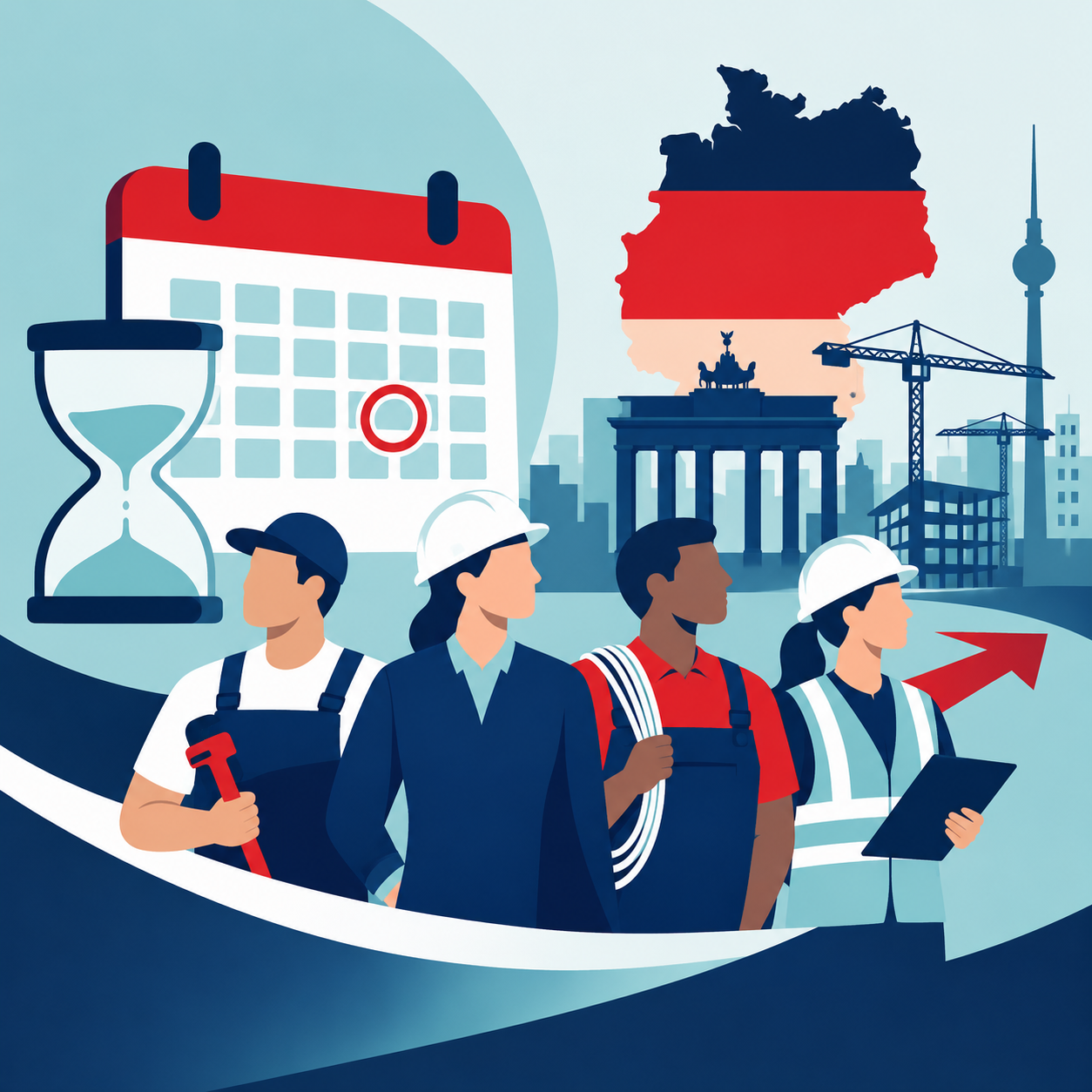
Germany has long been known for its skilled workforce, strong infrastructure, and central European location. What’s changing now is the timing. Over the next 12–18months, labor market dynamics, policy direction, and sector-specific growth are aligning in a way that favors companies ready to expand thoughtfully rather than reactively.
A Stable Economy Advantage
Germany’s economy is often described as steady rather than explosive, and for employers, that’s good news. According to the European Commission’s latest outlook, Germany’s GDP is expected to grow by around 1 percent or more in 2026, marking a return to expansion after two subdued years.
This represents a clear shift from 2024–2025, when inflationary pressures, cautious investment, and delayed hiring kept many expansion plans on hold. As those pressures ease, companies now have space to plan and build.
For growing businesses, this environment supports predictable costs, long-term workforce planning, and sustainable hiring rather than reactive expansion. In other words, Germany is not a boom-and-bust market.
Demand for Skilled Talent
Despite slower growth in recent years, labor demand in Germany remains high. Data from the German Federal Employment Agency shows more than 600,000 registered job vacancies, with over one million open roles across the wider market. The majority of these positions are for qualified professionals and specialists.
Crucially, this demand is concentrated in sectors actively shaping Germany’s future.
A Workforce for International Teams
Germany isn’t just Europe’s largest economy; it’s also linguistically diverse. Around 17 percent of people in Germany speak German and at least one other language at home, according to the Federal Statistical Office (Destatis). Beyond that, broader EU surveys show that nearly three-quarters of Germans can communicate in a foreign language, with more than a third able to speak multiple languages.
For international companies, this means fewer barriers when building cross-border teams, particularly those operating in English-first environments and serving global clients.
Growth Sectors Are Actively Hiring
Several industries stand out as strong opportunities for international companies looking to build or expand teams in 2026. These include tech, software, AI, finance, and fintech. In fact, Germany’s energy transition has been proof of this, translating directly into jobs. For example, positions tied to renewables have more than doubled since 2019, reflecting long-term demand for clean energy.
Opportunity for Those Who Move Early
Germany’s labor market is tight, which creates an advantage for companies willing to plan ahead. Official data shows skill shortages in more than 160 occupations, spanning engineering, healthcare, IT, construction, and technical trades. Around one in four German companies report difficulty finding qualified staff. For expanding businesses, this means speed, flexibility, and hiring early matters.
As confidence returns in 2026, competition for top talent is likely to accelerate quickly. Companies that establish a presence and begin hiring early can secure high-quality candidates before demand peaks, while others are still waiting for clearer signals.
Germany as a Long-Term European Hub
Germany isn’t just a market; it’s a base. Its central location, strong transport links, and access to the wider EU make it an ideal place to build a European hub.
Even in a steady economy, the combination of GDP growth, demand for skilled professionals, and the snowballing momentum in key sectors means that those companies that plan now can benefit in the long term.
As Europe’s economic cycle turns, Germany may not be the loudest or fastest-growing market, but it could be the smartest place to build. For companies thinking beyond the next quarter, 2026 may be the year that early, strategic hiring in Germany pays off.
Find out more about how we act as an Employer of Record Germany here.