
An introduction to Employer of Record Services
Expanding your business internationally can be challenging, but a global expansion employer of record makes it easy to hire talent, ensure compliance, and accelerate growth in new markets. This whitepaper offers a comprehensive guide to expanding your business with an Employer of Record service. Having grown in popularity since it was first established in around 2010, the use of an international EOR service is now common practice for organisations to establish their first overseas hires.
Using an EOR to facilitate global expansion enables a growing business to move quickly, mitigate the risks of non-compliance in the foreign jurisdiction, and, importantly, withdraw easily should the need arise. While there is a cost attached to working with an EOR, it is typically lower for a small number of employees than a traditional entity establishment route. There is also less impact on the businesses’ own resources as much of the work is taken on by the EOR service provider.
Employer of Record services are commonly used to formalise the engagement of a consultant or freelancer. This is often when an individual was quite legitimately first self-employed. Over time, responsible businesses want to ensure the individual is being treated the same as their pay-rolled staff, and has the benefits and protections associated with being an employee. Additionally, new and changing legislation, such as IR35 in the UK, seeks to clamp down on the misclassification of employees as contractors.
In an industry rife with acronyms, in may help to be aware of other terms used for related services:
- PEO (Professional Employment Organisation), often used in the United States to describe a co-employment relationship. In this situation, the PEO company takes on payroll and HR responsibilities for the client’s own employees (as opposed to an EOR where the employment contract is between the employee and the EOR company).
- GEO (Global Employment Organisation) is an organisation employing around the world using an Employer of Record model.
This document discusses only Employer of Record services, though many of the points could equally apply to a PEO or GEO.
Understanding EOR Services
An Employer of Record company provides a service where they become the legal employer of one or more individuals on behalf of their client.
Once a candidate is identified (some EORs also offer recruitment, others do not), the EOR will provide an employment contract written under the laws of the country where the person will work. They then add the individual to payroll, which is run in that country, and take care of payroll deductions such as tax and social contributions.
The EOR also administers all mandatory benefits. The client company usually has the option to offer chosen supplementary benefit, via the EOR provider, such as health insurance, life assurance, or gym membership. The client company will provide the day-to-day direction to the employee, while the Employer of Record will support with HR advice as required.
Using an Employer of Record service to support an international expansion project can benefit a company by:
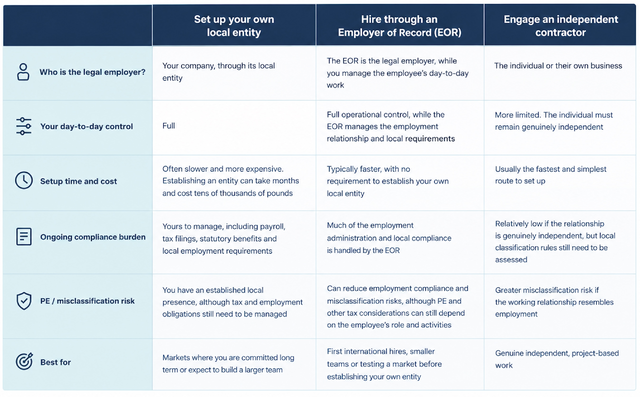
- Reducing the time to hire – The Employer of Record will be established and ready to employ on the business’s behalf, saving, in some cases, up to six months. This is how long it can take to establish a new entity and apply the necessary infrastructure to employ through it.
- Mitigating risk - By formally taking on the role of employer, an EOR service can help mitigate the risk of the legal and financial liabilities that come with employing staff in foreign countries.
- Reducing administrative burden - An EOR service helps reduce the administrative burden of hiring and managing international employees. The EOR will take care of HR-related tasks such as conducting background checks, drafting employment contracts, and onboarding employees.
- Reducing costs - For companies hiring a small number of employees, it’s typically more cost-effective to use an EOR than to establish their own local entity. Setting up to hire directly involves costs like registering and maintaining a foreign company, procuring HR and payroll services, and setting up benefits (e.g., pensions, insurance). Businesses should also consider the internal resource time and opportunity cost.
Offering country specific information - A strong EOR will provide guidance on regulatory red flags and cultural nuances, helping clients make informed decisions about international expansion. Collaborating with experts who’ve supported multiple expansions brings invaluable insight and is something that is often overlooked.
Key considerations for global expansion with an EOR
Consider… How an EOR can support How will you ensure compliance with local employment laws and regulations, such as tax withholding, social security contributions, and minimum wage requirements? As the legal employer, your EOR partner has a vested interest in you getting these things right and will advise if you are not meeting requirements such as minimum wage. Your Employer of Record will also offer protections against non-payment of payroll related taxes and social security contributions. Do you have adequate legal expertise relating to your overseas jurisdiction? An Employer of Record will have its own legal counsel, either retained or directly employed, in each foreign jurisdiction. Is your internal HR function equipped to advise management on employment protocols in your target country? An EOR service commonly starts with the provision of a locally compliant contract of employment. The EOR then offers ongoing HR advice as part of their service, keeping you safe regarding employment laws. They can even advise on the key considerations and potential costs involved if a termination scenario arises. What are your business drivers for overseas expansion, and do they necessitate a timeline to hiring? Each business will have its own reasons for making an overseas hire. It maybe the formalisation of an existing consultant engagement as an employee, a brand-new hire as part of a strategic growth plan, or even one or more employee’s being inherited via a merger of acquisition.Sometimes, specific circumstances create a deadline for getting a new employee on payroll. In such cases, the “off-the-shelf” services of an EOR can be the most effective way to set up quickly. Have you asked all the right questions to understand and mitigate risk? A good Employer of Record will help you manage the risks of overseas expansion by ensuring giving you answers to the questions you didn’t even know to ask. They will have local knowledge of cultural expectations, as well as legal parameters.
Best practices for global expansion with an EOR
Any business considering its overseas growth should first develop a comprehensive expansion strategy.
To start, this will mean conducting thorough research on your target market. Businesses will have a range of commercial considerations, such as market size and potential, the competitive landscape in their sector, and the quality of the country’s infrastructure and logistics. They should also consider their new workforce. Are there enough people with the right qualifications and language skills, and are typical salaries commercially viable? How tough are the labour laws, and are the statutory employer costs a large overhead? A good Employer of Record will be able to help with these.
Once these are established, prioritise your new overseas employees within your plan. It may seem obvious to those who regard people as the most important thing about their business, but this can often be overlooked in favour of infrastructure and operations. Having the key talent could be a deciding factor in the success or demise of your global expansion.
Finally, choose the right Employer of Record for you. There are now many international EOR service providers, giving businesses plenty of choice. Employers should assess how much advice and support they require when hiring overseas to determine whether a tech-only platform is sufficient or if a more consultative approach would add value.
There are single-country providers such as PEO Italy, regional vendors like Africa, and HR and global providers like Agility EOR. So, ask yourself, do you need to engage a single country specialist or a business with a broader reach?
Limitations of using an EOR
At the right stage, for the right project, an Employer of Record service can be invaluable to expanding a business. However, it is important to consider when an EOR might not be the right option, and where the limitations of the service lie.
The most obvious is that it makes more economic sense to bring the services offered by an EOR in-house. At a critical number of employees, functions such as HR and payroll can be supported by your own foreign entity. At this point you will have built sufficient local knowledge within your team to run things smoothly yourself. Although every situation is different, it is reasonable to say that generally, Employer of Record services are most suited to a small number of employees.
Using an Employer of Record does not provide a mechanism for your business to pay corporation tax overseas. Most EOR providers will not conduct a thorough assessment of your permanent establishment (PE) risk and won’t offer any protection against it. Businesses with concerns about PE risk should seek specialist tax advice before deciding to engage an EOR or establish a local legal entity.
Similarly, if you're hiring a foreign national to work in a country, they may require a visa and work permit. In some cases, the EOR can assist with this process and may even sponsor the visa through its own legal entity. However, in many countries (including the UK) having an EOR sponsor a visa and then lease the employee to a client would breach immigration rules. This could result in the EOR losing its sponsorship licence and the employee losing their right to work.
Therefore, if visa sponsorship is required, it’s essential to seek independent immigration advice to determine whether using an EOR as the sponsor is a compliant and sustainable option.
Business should also remember that using an EOR doesn’t devolve them of all responsibility. All costs associated with having the international employees will ultimately be met by the business, including costs associated with termination. As the responsibility for day-to-day line management lays with the globally expanding business, it should make sure its managers treat all employees equally, fairly, and follow the correct processes in the foreign jurisdiction. The Employer of Record service cannot protect its client without good two-way communication.
Conclusion
An Employer of Record (EOR) service won’t be the right solution in every situation.
However, for businesses looking to move quickly, operate compliantly, and lacking internal expertise or resources, an EOR can be a highly effective tool for global expansion.
Remember, there are variations in both the scope of services EORs offer and the way they deliver their support. Some provide platform-based solutions, while others take a more consultative, hands-on approach.
If you believe an EOR might be the right fit for your business, start by taking advantage of free consultations from reputable providers before choosing your partner.