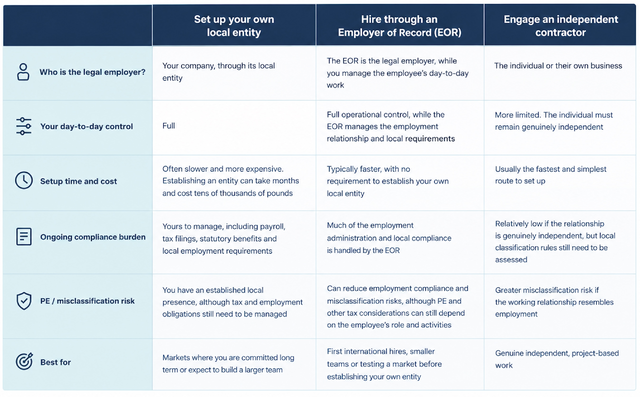

Hiring internationally is no longer a question of if — it is a question of how. An Employer of Record (EOR) lets you employ talent anywhere without setting up a local entity, taking on the payroll, tax and compliance obligations as the legal employer on your behalf. The market has matured quickly, and the providers now fall into two broad camps: automated software platforms built for scale, and service-first partners built for relationships.
Both models can employ someone in Germany or Singapore next week. Where they differ is in everything that happens after the contract is signed — how flexible the employment agreement is, whether you can reach a human who knows your account, whether anyone is watching your account proactively, whether the true cost is clear upfront, and whether you are locked into paying for employees you no longer have. This guide compares the five most-searched EOR providers of 2026 against those five buyer-critical dimensions and shows where a high-touch alternative such as Agility EOR fits.
How to actually compare EOR providers
Country coverage and headline price get most of the attention, but they rarely decide whether the relationship works — or what it truly costs. Five less-visible factors do far more, and they are exactly where automated platforms tend to be weakest.
- Contract flexibility. Can the employment agreement be tailored to your terms — notice periods, IP clauses, bonus structures, restrictive covenants — or are you handed a boilerplate template you cannot change?
- Human support. When something urgent happens, can you phone a named person who already knows your account, or do you file a ticket and wait?
- Proactivity. Does the provider actively monitor your account — flagging pay, benefit and compliance issues before they become problems — or only respond once you raise them?
- Pricing transparency. Is the full cost of the service set out clearly in one agreement, or does it only become visible once you’re committed — split across separate schedules of work that reveal the final fee later in the process?
- Headcount lock-in. If you commit to five employees but two leave mid-year, do you keep paying for all five until the term ends — or only for the people you actually employ?
Two of these are pure money, and both are easy to miss. Fragmented fee structures are one of them: some providers only confirm the full cost via a separate schedule of work, disclosed once a candidate is already keen to start and negotiating leverage has gone.
Headcount lock-in can cost even more. Some providers structure EOR as an annual, committed-headcount or minimum-term agreement: if you sign for five employees and two leave after six months, you can stay liable for the service fees on all five until the term expires. On a small team that can mean paying for empty seats worth tens of thousands over a year — a cost that never appears in the headline per-employee price, and one of the single biggest reasons to read the contract term carefully before you sign.
At a glance: platforms vs. a service-first partner
The table below summarises the structural differences. The sections that follow examine each provider individually.
1. Deel

The scale leader. Deel is the most recognised name in the category, with wholly-owned entities in 130+ countries, a slick dashboard and top G2 rankings across EOR and global payroll. It is trusted by tens of thousands of companies and is a strong choice for organisations that want a single platform to run hundreds of workers with minimal hand-holding.[3]
Where it frustrates buyers. Because the contract experience is standardised across the platform, buyers with unusual employment terms or complex jurisdictions often find there is limited room to customise the underlying agreement — the trade-off that comes with software built for scale.
2. Remote
.avif)
The owned-entity purist. Remote employs people only in countries where it owns the legal entity, which gives a consistent experience across its footprint of around 100 countries. Notably, it publishes a Fair Price Guarantee, a genuine point of difference on pricing clarity from several rivals.
Where it frustrates buyers. The recurring theme in verified reviews is reachability. Customers report that support response times can be slow for time-sensitive issues, that complex compliance questions can take 24–48 hours for a substantive answer, and that it can be a struggle to get past the AI 'helper' to reach a person. Several reviewers describe Remote as simply 'impossible to reach' at the moment they most needed help.
On contracts, Remote offers flexible setups for employees and contractors, but its EOR agreements carry a 12-month minimum term with automatic renewal — so if you release an employee early, you can still owe service fees for the remainder of the term. It is a clear example of why the headcount and term clauses deserve as much scrutiny as the monthly price.
3. Globalization Partners

The enterprise incumbent. G-P effectively created the EOR category and offers the broadest coverage on this list — 180+ countries — making it a natural shortlist entry for large, complex, multi-market rollouts.
Where it frustrates buyers. Two themes dominate the critical reviews: cost and accountability. Analyst estimates put G-P's effective cost at roughly USD 950–1,500+ per employee per month after add-ons — a 15–20% premium over Deel and Remote — with recurring feedback about limited pricing transparency and added charges that create budgeting friction. On service, reviewers describe having to repeatedly follow up for complete, country-specific guidance, incomplete responses, and 'weak process accountability' where delivery does not always match the promise.
For a buyer who wants a named owner of their account rather than a rotating support queue, that accountability gap is the recurring complaint — and the cost premium buys coverage, not necessarily attention.
4. Papaya

The payments-first platform. Papaya is built for finance-led teams that want to consolidate multi-country payroll and gain visibility into global payment rails — a natural fit for a CFO persona focused on consolidated reporting.
Where it frustrates buyers. The model is the catch. Papaya acts as the legal employer through an aggregator (in-country partner) network in most markets, which means compliance execution — and service quality — varies by partner rather than being uniform. The most serious complaints cluster around payroll accuracy: delayed payments, incorrect tax handling, and extended resolution timelines. Support divides sharply by channel, with first-line help during payroll cycles rated markedly lower (Trustpilot around 3.3/5) than the platform overall, and issues often only addressed once escalated.
5. Rippling

The all-in-one operating system. Rippling's strength is breadth: HR, IT and payroll in one system, so you can provision a laptop and app access alongside a global hire. For a US-first company standardising its whole operating stack, that consolidation is genuinely useful.
Where it frustrates buyers. Its EOR footprint is narrower than it first appears — owned entities in roughly 40 countries and EOR hiring in around 32, with partners filling much of the rest. The critical reviews are pointed: no live support for EOR customers (email responses in 24–48 hours), BBB complaints describing unresponsive account managers once the contract is signed, and pricing that reviewers say reveals its true total only after signing, via modular billing, undisclosed implementation fees and peak-headcount charges.
Some customers also report being sold on country-specific expertise that did not materialise, with compliance mistakes in markets where they had been assured of depth. For EOR specifically, the support model is the weak point.
The service-first alternative: Agility EOR
Every provider above is a capable platform. The pattern in their critical reviews, though, is strikingly consistent — and it maps exactly onto the five dimensions that decide whether an EOR relationship actually works, and what it costs. This is the space a service-first partner is built for.
Contracts built around you, not a template
Rather than issuing an automated, one-size-fits-all agreement, Agility reviews each employment contract together with the client and tailors it to your preferred terms — provided they stay within the law of the country in question. Where platforms hand you boilerplate you cannot change, custom clauses are the starting point of the conversation, not an exception to it.
A phone number and a person who knows your account
Agility publishes a phone number for a reason: when you call, a named professional who already knows your account answers — not a ticketing queue, an AI helper, or an outsourced telesales line. With an internal team ratio of roughly one specialist to every ten client employees, questions are answered by someone with context, and straightforward contracts are frequently turned around within the hour.
Proactive, not reactive
The most common complaint across the platforms is that support only engages once you raise a ticket. Agility's model inverts that: the team works the account proactively — checking that employees are being paid correctly and that compliance obligations are being met — so problems are caught before they reach you, rather than after.
Clear, transparent pricing
Where other providers can split costs across separate schedules of work — often only revealing the full fee once a candidate is keen to start — Agility's pricing is simple and set out in full in one service agreement from the outset. What's in the agreement is what you pay: no hidden extras.
Pay for the team you actually have
Agility does not tie clients into committed employee numbers. If a five-person team becomes three mid-year, you pay for three — not for empty seats sitting on an annual commitment until a contract term runs out. Over a year, that single difference can outweigh every other line on the invoice, and it is one of the most important things to check before signing with any provider.
Choosing your EOR partner: six questions to ask
Switching EOR providers means re-signing every international contract, so it is worth getting right the first time. Put these six questions to any provider on your shortlist — the answers separate a platform from a partner.
1. Owned or partner entities? Does the provider own the entity in your target country, or route through a third-party aggregator? Aggregators add a layer of cost and a degree of separation that can slow communication and vary compliance quality by market.
2. Am I tied to a committed headcount? Confirm whether you pay per active employee, or whether an annual or minimum-term seat commitment means you keep paying for people who have left until the term ends. On a small team this can be the single largest hidden cost.
3. Is the full cost in one agreement? Ask to see the complete fee structure upfront. If costs are only confirmed via a separate schedule of work once a candidate is already in process, treat that as a red flag.
4. Can the employment contract be customised? Confirm whether you can add custom clauses (IP, notice, bonus, restrictive covenants) or are locked to a template.
5. Who picks up the phone — and do they know my account? Establish whether you get a named contact with context, or a rotating ticket queue.
6. Is anyone watching my account proactively? Ask what the provider monitors on your behalf between your requests. Silence is the answer you do not want.
Frequently asked questions
Can an EOR charge me for employees who have left?
It can happen. Some providers use annual or minimum-term contracts tied to a committed headcount, so if you commit to a number of employees and some leave partway through the term, you may remain liable for the service fees on the seats you originally committed to until the term expires. Always confirm whether you are billed per active employee or against a fixed headcount commitment — on a small team it can be one of the largest hidden costs of all.
What factors should a business evaluate when choosing an EOR partner?
Look beyond country coverage and headline price. Assess whether the provider uses owned entities or third-party aggregators (owned models give more direct control and consistent compliance), whether you are tied to a committed headcount or pay per active employee, whether pricing is transparent — and declared in full upfront, rather than split across separate schedules of work — how customisable the employment contract is, whether you get high-touch human support rather than a self-service dashboard, and whether the provider manages your account proactively rather than only reacting to tickets.
Why do some EOR fees only become clear later in the process?
Sometimes. Some providers operate on separate schedules of work, so the complete fee structure is only confirmed once you are well into the hiring process — often after a candidate has accepted and has little patience for delay. The simplest defence is to ask for the full fee structure in writing, in one document, before you begin.
What is the difference between a software-first EOR and a service-first EOR?
Software-first providers (such as Deel, Remote, G-P, Papaya and Rippling) optimise for scale and self-service through a dashboard, which suits very large global teams. Service-first providers such as Agility EOR optimise for relationship and expertise — tailored contracts, a named human contact, proactive account management, transparent pricing and billing for the people you actually employ — which suits SMEs and scale-ups that value a dedicated partnership over an automated interface.
The bottom line
The no-entity model is the most efficient path to a global workforce, and any provider on this list can get someone employed quickly. The real question is what the relationship feels like — and what it costs — once the novelty of fast onboarding wears off: when you need a contract clause changed, a person on the phone, a problem spotted before it lands, clear pricing with no hidden extras, or the freedom to stop paying for people who have left. On those dimensions, the platforms consistently leave room for a partner who does them by design. If your priority is a dedicated, transparent, proactive relationship rather than a dashboard, a service-first EOR like Agility is built precisely for that gap.
Ready to compare on the things that matter
Talk to a named Agility EOR specialist — by phone — about tailored contracts, transparent pricing, proactive account management and paying only for the team you actually have. agilityeor.com.